
FloridaNet metering
LCEC net metering in Cape Coral: how solar credits work
Yes, LCEC has net metering. Extra solar power is banked and used against your later bills in the same year. What is left after the December bill is paid in January at a low wholesale rate, 2.875 cents per kWh for 2025. So size the system to what you use.
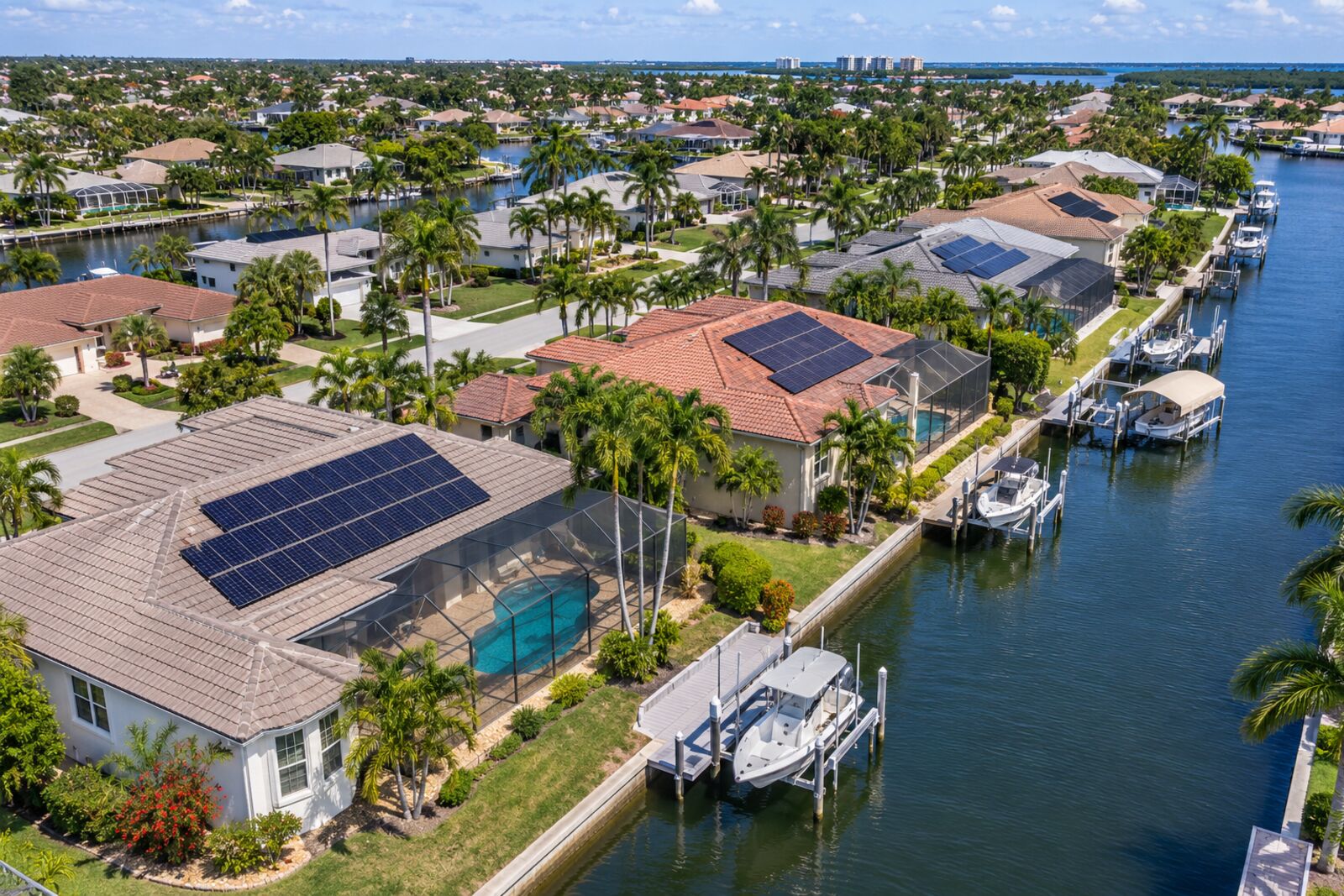
Does LCEC have net metering?
Yes. Lee County Electric Cooperative runs a net metering program for members with solar. LCEC describes it this way: “Energy not consumed when it is produced is sent to the grid as excess energy and is accumulated and accounted for in reserves to be drawn upon as needed to offset future energy use from LCEC.”
In plain words: on a sunny afternoon your panels make more than the house uses. The extra goes to the grid and LCEC counts it. At night you draw power back. You pay for the difference.
This matters in Cape Coral because LCEC serves customers there. LCEC says it serves “Cape Coral, North Fort Myers, Sanibel, Captiva, Pine Island, Everglades City, Immokalee, Marco Island, Ave Maria and parts of Lehigh Acres”, more than 240,000 customers in all. LCEC calls itself “a not-for-profit electric distribution cooperative”, and its solar page says “LCEC does not generate power”. If your bill comes from FPL, the rules are different. See Florida solar incentives in 2026 for the FPL rule.
How does LCEC credit your extra solar power?
In kilowatt hours first, in dollars only at the end of the year.
LCEC’s rate tariff says that in each billing cycle, the kWh you send to the grid “will be deducted from the kWh delivered to the customer”, and the net amount is what you are billed for. If you send out more than you took in a month, the extra is “carried forward as a kWh credit to the end of the calendar year”.
So one kWh you bank in April can cancel one kWh you use in August. That is the valuable part.
What does LCEC pay for power left over at the end of the year?
Very little. LCEC’s guidelines say that reserves “remaining after the December billing will be payable to the member in January at the calculated avoided wholesale rate for the prior year.”
The guidelines give the number: “The calculated avoided wholesale rate for calendar year 2025 is $0.02875 per kWh.” That is 2.875 cents.
Compare that with the rate you are billed on. On the Net Metering Rider the energy charge is 8.21 cents per kWh, before the power cost adjustment. A kWh you bank and use later offsets a kWh at that kind of price. Power left in the bank at the end of 2025 is payable at 2.875 cents.
Two more details from the guidelines:
- If the year-end amount is less than $300, it comes as a credit on your bill. All other amounts are paid by check.
- LCEC’s own advice: “it is prudent for members to install an RGS that produces up to the amount of energy the member uses in a year.” RGS means renewable generation system.
That is the main lesson for an LCEC home. A bigger system is not a better system. The right size is your own yearly use, or a little under.
What are the LCEC net metering tiers and fees?
LCEC sorts systems into three tiers by size.
| Tier | System size | LCEC fee | Insurance proof |
|---|---|---|---|
| Tier 1 | 0 to 10 kW | $35 interconnection fee | Not listed for Tier 1 |
| Tier 2 | More than 10 kW, up to 100 kW | $300 interconnection fee | Required, amount set in the agreement |
| Tier 3 | More than 100 kW, up to 1 MW | $1,000 application fee | Required, amount set in the agreement |
Systems of 10 kW or less are Tier 1. For Tier 1 and Tier 2, LCEC bills the fee to your account after it approves the agreement. For Tier 3, LCEC says the $1,000 application fee is required to process the interconnection request.
How LCEC measures size: for inverter systems, the gross power rating is the total AC capacity of the inverters. If the panels’ total DC capacity is less than the inverter AC output, LCEC multiplies the DC capacity by 0.85.
Does the net metering rate at LCEC differ from the normal rate?
Yes. LCEC has a separate Net Metering Rider in its tariff. The tariff file on LCEC’s site lists these residential numbers:
| Standard residential rate | Net metering rider | |
|---|---|---|
| Customer charge, single-phase | $20.00 a month | $22.22 a month |
| Energy charge | Three steps: 11.29, 12.06 and 12.82 cents per kWh | One flat charge: 8.21 cents per kWh |
Both rates also carry a power cost adjustment that changes over time. The tariff also says a net metering customer is never billed less than the minimum charge, which is the customer charge. So a solar home on LCEC always has a monthly bill of at least that amount.
Rates change. LCEC tells members to review the rates before signing up, and so do we. The rider starts on page 27 of the tariff file in the sources below.
How do you apply for LCEC net metering?
LCEC lists five steps. The account holder must complete them.
- Keep the system off. Except for testing and inspection, the manual disconnect stays open until the new meter is in.
- Review the LCEC guidelines and the interconnection agreement for your tier.
- Review the LCEC rates.
- Complete the electronic interconnection agreement and the application and compliance form, and send the supporting documents: the passed city or county inspection, a one-line electrical diagram, and the spec sheet of the inverter and other installed equipment. Tier 2 systems also send proof of insurance. For Tier 3, LCEC asks you to contact its designers before you apply.
- Wait for the Permission to Operate letter. Then turn the system on.
Three rules in the guidelines catch people out:
- Do not run the system early. LCEC says running it before the bidirectional meter is installed “is prohibited and may result in meter tampering penalties”, and you get no credit for that period.
- You need a manual disconnect switch. LCEC says one “is required for all RGS installations”. LCEC says it should disconnect only the solar, not the whole house.
- The system shuts down when the grid goes down. LCEC requires this “to prevent dangerous back feed” that could hurt the public and the crews working on the grid.
LCEC’s net metering contact is Customer Care at 239-656-2300 or LCECNetMetering@lcec.net.
Questions people ask
Does LCEC buy back solar power?
Not month by month. Extra power is banked in kWh and used against your later bills in the same year. Only what is left after the December bill is paid out, in January, at the avoided wholesale rate. For 2025 that rate was 2.875 cents per kWh.
Is LCEC net metering one to one?
Within the calendar year, yes in kWh. The tariff deducts the kWh you send out from the kWh you take in, and carries extra kWh forward to later months. At the end of the year the leftover is paid at the low wholesale rate, not at the retail rate.
How much does LCEC charge to connect solar?
$35 for Tier 1 systems up to 10 kW, $300 for Tier 2, and a $1,000 application fee for Tier 3. LCEC bills the Tier 1 and Tier 2 fee to the account after the agreement is approved.
Will my LCEC bill go to zero with solar?
No. The tariff says a net metering customer is never billed less than the minimum charge. On the net metering rider the single-phase customer charge is $22.22 a month.
Who is the electric company in Cape Coral?
LCEC, Lee County Electric Cooperative, serves customers in Cape Coral. Your bill shows which utility serves your home. LCEC lists Cape Coral first among the places it serves. It is a not-for-profit cooperative and it does not generate power itself.
Does solar work during a power outage on LCEC?
LCEC requires the solar system to shut down when the LCEC grid shuts down, to protect the public and line workers. Ask your installer what a battery changes for your home, and get the answer in writing.
Sources
- LCEC, Net Metering Guidelines (PDF). File dated December 22, 2025. Read November 15, 2026.
- LCEC, Net Metering program page. Read November 15, 2026.
- LCEC, How to Participate in the Net Metering Program (PDF). Read November 15, 2026.
- LCEC, Rate Tariff Sheet 2026 (PDF). Residential rate schedule RS and the Net Metering Rider. Read November 15, 2026.
- LCEC, About LCEC. Service area and customer count. Read November 15, 2026.
- LCEC, Solar. Read November 15, 2026.
Facts on this page were checked against the sources above on November 16, 2026. Rules and rates change. Confirm the current numbers with your utility or a tax professional before you sign anything.